
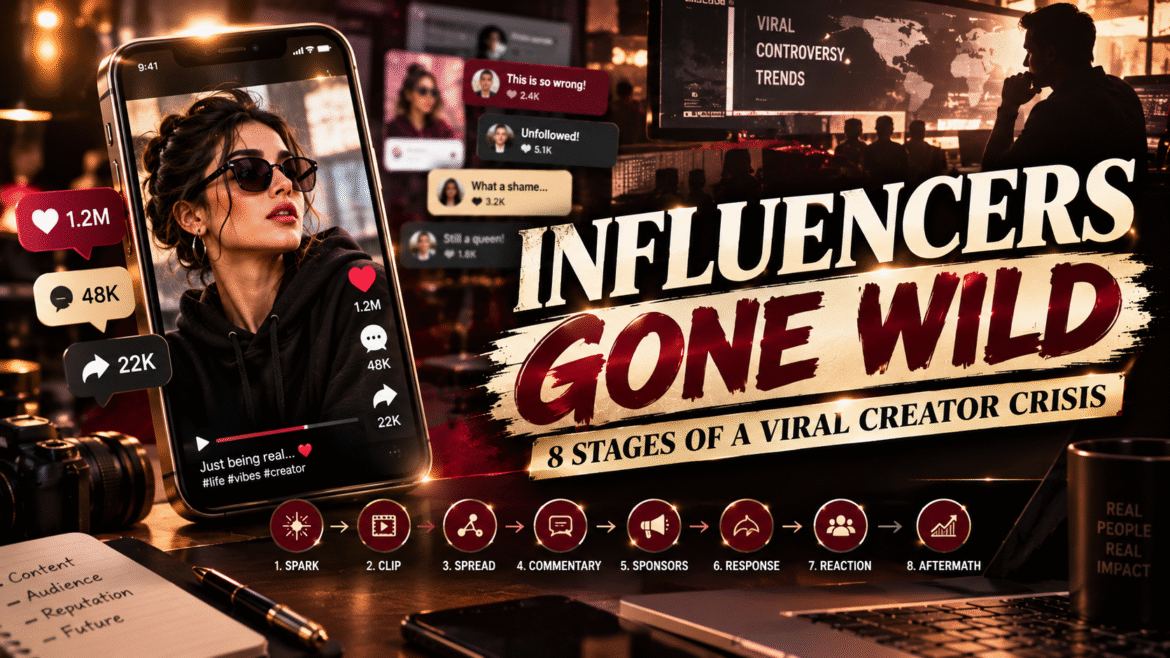
A creator controversy rarely begins and ends with one post. A livestream, product recommendation, public argument or behind-the-scenes clip can move through several stages before most viewers even understand what happened. The first audience sees the original moment. A second audience sees a clipped version. A third encounters commentary, reaction videos and headlines that may frame the event in a completely different way.
That journey is worth understanding because online reputation is not shaped only by what a creator publishes. It is also shaped by how platforms distribute material, how audiences interpret it, how other accounts repeat it and how the creator responds. The phrase influencers gone wild is often used as a headline for surprising online behaviour, but the story behind a viral moment is usually more complicated than the headline suggests.
This guide follows a controversy from its earliest spark to its possible aftermath. It looks at eight stages, explains the decisions that matter at each point and offers a practical way for creators and viewers to respond without making an uncertain situation worse.
Stage 1: The spark is usually smaller than the story that follows
A viral controversy may begin with something ordinary: a joke that lands badly, an advertisement that lacks context, an argument during a livestream or a careless statement made in a hurry. The original event might reach only a small group at first. Its later scale can make it seem as if the entire internet witnessed the moment simultaneously, even though distribution happened in stages.
This is one reason the phrase influencers gone wild can be misleading. It may suggest a dramatic, self-contained incident when the actual starting point was a short exchange with missing background. Before deciding what a moment means, identify the earliest available source and establish what was actually said or shown.
Creators can reduce avoidable confusion by reviewing posts before publication, checking claims and considering how a joke or demonstration could be understood outside its original setting. Viewers can do their part by resisting the urge to judge a person from a single screenshot. This shapes influencers gone wild coverage.
Stage 2: The clip becomes a portable version of the event
Short video is easy to copy, crop and repost. A clip may be separated from the conversation that came before it or the explanation that followed it. Captions, subtitles and reaction overlays can also guide viewers toward a particular interpretation. Once the material travels, the original creator may have little control over how it is presented.
When people search for influencers gone wild, they may encounter several versions of the same moment. One may be a complete recording; another may be edited; a third may include commentary that sounds like confirmed reporting. These versions should not be treated as equally reliable.
A useful verification habit is to locate the original upload, check its date and compare it with a longer recording if one exists. If the original is unavailable, say that the evidence is incomplete rather than filling the gap with assumptions. The Reuters Handbook of Journalism describes standards around accuracy, independence and verification that are useful principles for anyone assessing widely shared claims. Context matters in influencers gone wild stories.
Stage 3: Recommendation systems widen the audience
A post that receives attention can be shown to people who do not follow the creator. Those viewers may have no familiarity with the creator’s usual content, past statements or community. They arrive through a recommendation, a repost or a search result and interpret the moment with whatever context is available to them.
This change in audience can transform the tone of a discussion. A small community may understand an inside joke, while a wider audience sees only an offensive phrase. A creator may be speaking to regular customers, but a clipped advertisement can reach people who do not know it was sponsored. Discussions framed as influencers gone wild often grow when the material reaches audiences with very different expectations.
Creators should assume that public posts can travel beyond their intended audience. That does not mean every post must be bland. It means the context should be clear enough that the content can stand on its own when shared. Audiences should also remember that a recommendation feed is not a neutral record of public opinion; it is a system that selects what each viewer sees. This complicates influencers gone wild narratives.
Read more: About Qushvolpix Product: 11 Essential Facts and Smart Buyer Tips
Stage 4: Commentary turns uncertainty into competing narratives
Once a moment attracts attention, other creators may explain it, criticise it, defend it or turn it into entertainment. Commentary can add useful context, especially when the commentator has relevant expertise or access to primary evidence. It can also introduce speculation, exaggeration or personal attacks.
At this stage, influencers gone wild can become a label applied to several different claims at once. One post may discuss the original action, another may speculate about motivation, and another may repeat an allegation that has not been verified. Viewers can easily mistake repetition for proof.
A careful reader should separate three things: what the original material directly shows, what a reliable source has independently confirmed and what people are merely inferring. Those categories should not be blended. The Poynter Institute provides journalism and fact-checking education that can help readers develop stronger verification habits.
Commentators have responsibilities too. They should distinguish reporting from opinion, link to source material where possible and correct errors visibly. Criticism can be sharp without pretending that uncertain details are established facts. This reframes influencers gone wild discussions.
Stage 5: Commercial relationships come under scrutiny
A controversy can expose questions that were not obvious in the original post. Was the creator paid? Was a product gifted? Did the creator actually use the service? Was a discount code connected to a commission? These questions matter because a recommendation can influence purchasing decisions.
The phrase influencers gone wild may attract attention to a promotion that viewers consider misleading, but the important issue is transparency. Advertising is not automatically deceptive; undisclosed advertising can make it difficult for an audience to understand the relationship behind a recommendation.
The U.S. Federal Trade Commission offers Disclosures 101 for Social Media Influencers, which explains how creators can make material connections clear. Its Endorsement Guides resources provide further guidance on endorsements and reviews. Requirements vary by jurisdiction, so creators should check the rules relevant to their location and audience.
A practical standard is simple: disclose paid, gifted or commission-based relationships clearly and close to the recommendation. Do not imply independent testing if no testing took place. Keep records of agreements and product claims so that questions can be answered accurately. This influences influencers gone wild reactions.
Stage 6: The response becomes part of the evidence
A creator’s first response can influence how an incident develops. A rushed denial may conflict with available footage. A vague apology may leave affected people unsure what is being acknowledged. A defensive livestream can introduce new claims that distract from the original issue.
When influencers gone wild becomes a trending topic, the pressure to respond immediately can be intense. But speed is not always the same as responsibility. If the facts are still unclear, a creator can acknowledge that they are reviewing the situation and provide a reasonable time for a fuller response.
A useful response has four parts:
- Identify the specific action or statement being addressed.
- Correct factual errors without attacking critics.
- Acknowledge the impact on people who were affected.
- Explain the practical step that will prevent a repeat, where a change is needed.
An apology should not demand instant forgiveness. It should not shift blame onto viewers for reacting, and it should not promise changes that the creator has no intention or ability to make. If the matter involves legal, safety or employment issues, professional advice may be necessary before making detailed public statements. Context can change influencers gone wild interpretations.
Stage 7: The audience decides whether accountability is proportionate
Public reaction is not a single verdict. Some viewers may stop following the creator. Others may wait for more information. Customers may ask for refunds, sponsors may review agreements and supporters may continue watching. Different groups have different reasons for responding.
This is where influencers gone wild can turn into a lasting reputation problem. Search results and reposts can preserve a controversy after the original discussion has moved on. Yet an online audience should not become an unlimited punishment system. Criticism should focus on relevant actions, credible evidence and proportionate consequences.
Viewers can ask whether the response addresses the harm, whether the creator has corrected the record and whether the proposed consequence is connected to the conduct. They should avoid sharing private addresses, phone numbers, family details or unrelated personal information. Harassment does not become accountability simply because a controversy is popular.
Creators, meanwhile, should not treat every critical comment as abuse. Legitimate criticism can reveal a gap between what a creator intended and what an audience experienced. Listening does not require agreeing with every accusation; it requires assessing the substance rather than dismissing the person who raised it. This affects influencers gone wild reputations.
Stage 8: The long-term outcome is determined by what changes
A viral moment may fade from trending pages, but its effects can continue. A creator may change how sponsorships are reviewed, add context to educational content, stop sharing private information or introduce a process for correcting errors. In other cases, the creator may make no meaningful changes and the same problems may return.
The most useful lesson from influencers gone wild is that reputation is built through repeated behaviour. One statement cannot substitute for consistent transparency. One apology cannot prove that a process has changed. Equally, one mistake does not tell an audience everything about a person’s future conduct.
Creators can make improvement measurable. They can publish clearer sponsorship disclosures, keep a correction log, create a review checklist for sensitive posts and set boundaries around private life. Audiences can look for evidence of those changes rather than relying only on a polished statement. This affects influencers gone wild audiences.
A practical response plan for viewers
Before sharing a controversial creator post, use this quick sequence:
- Find the earliest source you can reasonably access.
- Check the publication date and whether the clip is complete.
- Separate direct evidence from commentary and speculation.
- Look for credible independent reporting or relevant documentation.
- Read the creator’s response, but do not treat it as the only source.
- Avoid repeating claims that remain unverified.
- Do not publish private information or encourage harassment.
This routine is especially useful when a post is tagged influencers gone wild. A catchy phrase can help people discover a discussion, but it cannot establish the facts. If you cannot verify a claim, describe it as unconfirmed or leave it out. It can clarify influencers gone wild claims.
A reputation checklist for creators
Creators can prepare for difficult moments before they happen. Keep a record of sponsorship terms, verify product claims, label commercial relationships, review sensitive posts before publishing and decide which personal topics will remain private. Have a trusted person review a high-stakes statement before it goes live. If a correction is needed, make it visible rather than quietly changing the original material without explanation.
The goal is not to eliminate all criticism. A creator who publishes to the public will sometimes encounter disagreement. The goal is to make the work accurate, transparent and respectful, and to respond constructively when something goes wrong. That approach is more sustainable than chasing every trend or trying to win every argument about influencers gone wild. This can slow influencers gone wild rumours.
Read more: Deepfakes and AI: Navigating the Risks to Digital Security
Frequently Asked Questions
What does “influencers gone wild” mean?
It is an informal phrase used for unexpected, controversial or attention-grabbing behaviour by online creators. It is not a formal classification and does not prove that a specific allegation is true. The facts must be assessed separately. This improves influencers gone wild discussions.
Why can one short clip cause a major controversy?
Short clips are easy to share and may reach people who do not know the original context. Editing, captions and commentary can influence how the moment is understood. A small event can therefore become a much larger public discussion. This helps assess influencers gone wild fairly.
How can I check whether a viral influencer claim is true?
Look for the original source, check the date, watch the full recording if available and compare the claim with reliable independent reporting. Do not treat repeated posts as independent confirmation. It adds nuance to influencers gone wild.
What should influencers do after making a public mistake?
They should identify the specific issue, correct inaccurate information, acknowledge genuine impact and explain what will change. They should avoid attacking critics or demanding immediate forgiveness. This matters in influencers gone wild coverage.
Are sponsored influencer posts allowed?
Sponsored content can be legitimate, but creators should follow applicable advertising rules and clearly disclose relevant financial or material relationships. The FTC guidance linked above is a useful starting point for creators working with U.S. audiences. It puts influencers gone wild claims in perspective.
Conclusion
A creator controversy is a process, not just a headline. It can move from a small spark to an edited clip, a wider recommendation audience, competing narratives, commercial questions and a public response. Looking at those stages makes it easier to understand why online stories grow and why quick judgments can be unreliable.
The phrase influencers gone wild may capture attention, but the better questions are what happened, what can be verified, who was affected and what changes afterward. Creators earn trust through transparent and consistent decisions. Audiences strengthen digital culture when they verify before sharing, criticise proportionately and refuse to turn uncertainty into harassment. Online fame can be unpredictable; responsible behaviour does not have to be.