
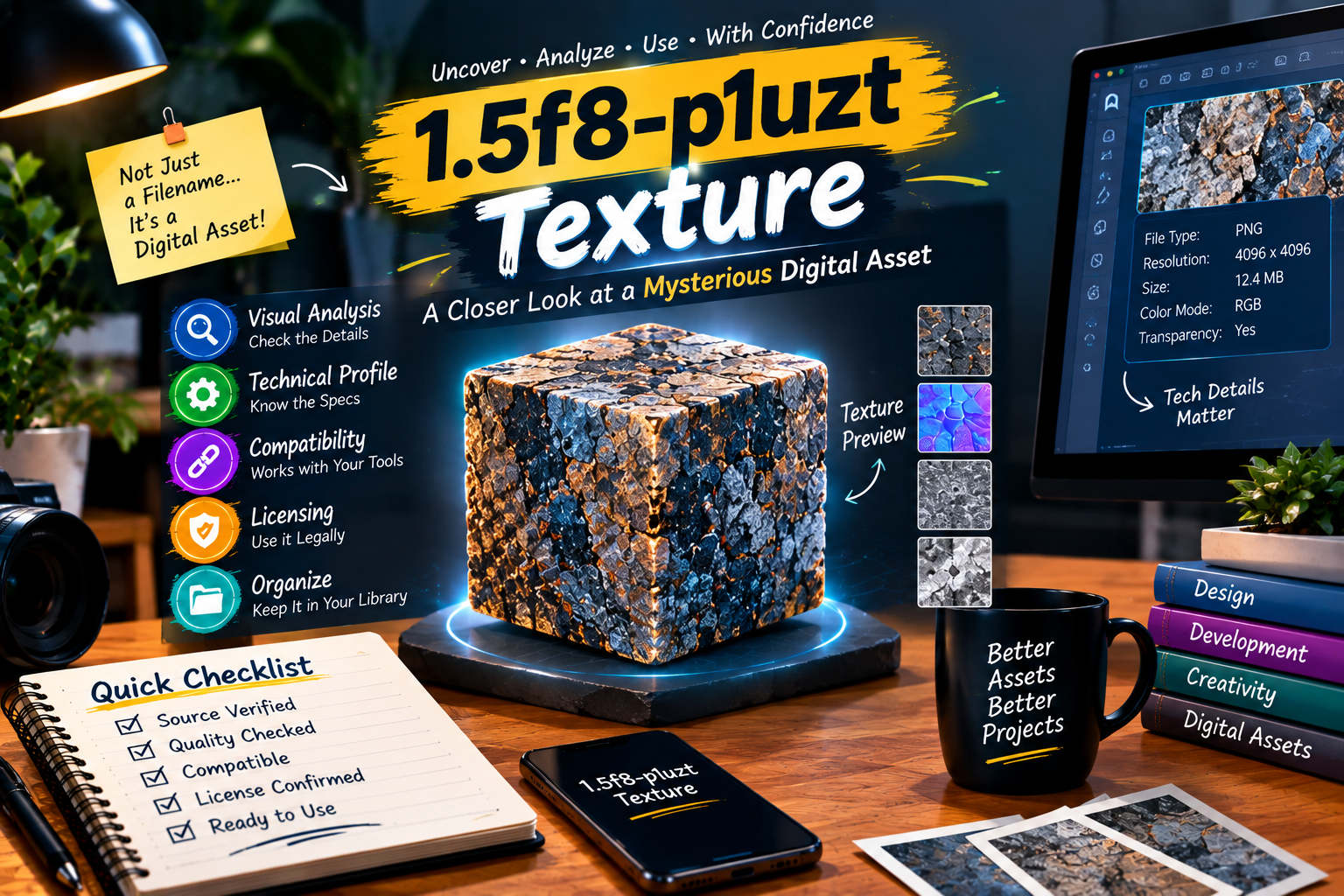
Introduction: Understanding an Unfamiliar Digital Label
Digital design projects often contain unusual filenames, coded identifiers, and asset labels that provide very little information at first glance. 1.5f8-p1uzt texture is an example of a term that may require additional context before its exact purpose can be understood. Instead of guessing what the identifier represents, a better approach is to examine its source, surrounding information, technical properties, visual appearance, and intended application.
This guide uses a practical research method to help designers, developers, creators, and curious users understand unfamiliar digital texture references. The goal is to turn an unexplained label into a properly documented digital asset through careful observation and verification.
1. Begin With the Original Context
The first step in researching 1.5f8-p1uzt texture is to locate the environment where the term originally appeared. It might be visible on a website, inside a project folder, within a software interface, or alongside other digital resources.
Context can provide important clues that the identifier itself does not reveal. Look at nearby headings, descriptions, filenames, categories, screenshots, and documentation. If several related assets appear together, their relationship may also help explain the role of the item.
Avoid changing the original name during the first stage of research. Keeping the exact identifier makes it easier to trace the source and compare information later.
2. Separate the Name From the Actual Asset
An important research principle is to distinguish between an identifier and the resource it identifies. 1.5f8-p1uzt texture may be a label, while the actual resource could be an image, material component, reference file, or another type of digital asset.
This distinction prevents incorrect assumptions. A strange name does not automatically describe the file’s technical function. Instead, identify the underlying resource and inspect its actual properties.
If the item is an image, examine its format and dimensions. If it belongs to a larger material system, look for associated files or documentation. If it appears in a design library, investigate how similar assets are categorized.
3. Look at the Visual Structure
Visual inspection can reveal useful information that cannot be obtained from a filename. When examining 1.5f8-p1uzt texture, pay attention to patterns, surface details, contrast, colors, edges, and overall consistency.
Pattern Behavior
Determine whether the image appears designed for repetition. A repeating texture should ideally avoid obvious seams when placed next to itself.
Detail Distribution
Look at areas containing fine details and larger visual shapes. A texture intended for close viewing may require more visible detail than one used at a small scale.
Color Relationships
Consider whether the colors are balanced and whether they fit the intended project. Strong contrast can make an asset visually dominant, while softer variations may work better as supporting elements.
Visual inspection should be treated as one stage of evaluation rather than proof of technical quality.
4. Create a Technical Profile
A simple technical profile can make 1.5f8-p1uzt texture much easier to evaluate. Instead of relying on appearance alone, record measurable properties that affect practical use.
A useful profile can include:
- File extension
- File size
- Pixel dimensions
- Color mode
- Transparency support
- Compression characteristics
- Source location
- Software compatibility
- Intended output
- Licensing information
These details can also help you compare the resource with alternative textures. A large file is not automatically superior, and a small file is not automatically unsuitable. The correct specification depends on the project’s requirements.
Keeping this information together creates a reliable reference for future use.
5. Identify the Intended Workflow
A digital asset becomes easier to understand when you know what kind of workflow it belongs to. 1.5f8-p1uzt texture should therefore be examined alongside the application or project where it appears.
Ask whether the surrounding environment is related to graphic design, website development, 3D production, gaming, digital art, presentations, or another creative process.
Screenshots and examples can be especially useful. If the original source demonstrates the resource in a particular environment, that demonstration may provide stronger evidence than assumptions based on the name.
Understanding the workflow also helps determine which technical characteristics actually matter.
6. Test Software Compatibility
Before building a project around 1.5f8-p1uzt texture, verify whether the underlying asset works correctly with your software.
Check supported formats, image dimensions, transparency, color handling, import behavior, and other relevant requirements. A file that opens correctly in one program may need conversion or adjustment in another.
A small test project is a practical way to discover compatibility issues before they affect a larger design. Always consider testing a duplicate instead of immediately editing the original.
Compatibility testing is particularly valuable when the asset will be shared with other designers, developers, or production systems.
7. Evaluate Resolution According to Purpose
Resolution should be judged according to the final use of the resource. When evaluating 1.5f8-p1uzt texture, ask how large the asset will appear and how closely the viewer will see it.
A high-resolution file may be useful for large visual surfaces or close-up presentation, while a smaller resource can be sufficient for thumbnails, backgrounds, icons, or compact interfaces.
Using unnecessary resolution can increase storage requirements without creating a visible improvement. On the other hand, reducing resolution too aggressively can remove details that matter to the final design.
The best choice is therefore based on actual project requirements rather than a simple preference for the largest available file.
Read more: About software wuvdbugflox: 10 Essential Insights for Smarter Software Research
8. Check Repetition and Seam Quality
Textures are often evaluated by how naturally they can extend across a larger area. If 1.5f8-p1uzt texture is intended for repeated use, inspect the edges carefully.
Place copies side by side and look for visible boundaries. Sudden changes in color, lighting, pattern direction, or surface detail can reveal seams.
Why Seam Testing Matters
A texture may look excellent as a single image but become distracting when repeated. Testing the edges early can prevent problems later in a design.
Practical Adjustment
If the asset needs modification, use a non-destructive workflow and preserve the original version. This allows you to compare the edited result with the source whenever necessary.
9. Consider Color and Editing Requirements
Different projects may require different color treatments. Before using 1.5f8-p1uzt texture, consider whether the original appearance needs adjustment for your design.
Possible changes can include brightness, contrast, saturation, cropping, scaling, or color correction. However, editing should be based on the project’s needs rather than automatically changing every asset.
If the resource is part of a larger visual system, consistency may be more important than making one texture visually stronger on its own.
Keep an untouched copy of the original file whenever possible. This provides a reliable reference and makes future revisions easier.
10. Research the Source and Ownership
Source verification is an essential part of responsible digital asset management. When you encounter 1.5f8-p1uzt texture, identify where the resource came from before using it publicly.
Look for creator details, official documentation, licensing information, attribution requirements, and restrictions on commercial use. A resource being publicly visible does not automatically mean that it can be reused without conditions.
If the original page provides terms of use, save those details with your project records. Clear source documentation can prevent confusion later, especially when an asset is shared among multiple people.
11. Add a Basic Security Check
Digital asset research should include basic file safety. Before opening or installing anything associated with 1.5f8-p1uzt texture, verify what type of file you are dealing with and where it came from.
An ordinary image should be approached differently from an executable, installer, script, or unknown archive. Be cautious when a supposedly simple asset is bundled with unrelated software or requests unexpected permissions.
Use trusted sources and keep normal security protections active. If something about the file or download process seems inconsistent with the expected resource, investigate further before proceeding.
12. Compare It With Alternative Assets
Comparison can help determine whether a resource actually fits your project. When comparing 1.5f8-p1uzt texture with other options, use consistent criteria.
Consider:
- Visual detail
- Resolution
- File size
- Color quality
- Repetition behavior
- Software compatibility
- Licensing
- Ease of editing
- Project performance
Avoid choosing an asset solely because it looks impressive in a preview. A practical texture should satisfy the requirements of the actual project.
A structured comparison also makes it easier to explain your choice to a client, teammate, or project manager.
13. Build an Organized Asset Record
Good organization becomes increasingly important as your digital library grows. Create a record for 1.5f8-p1uzt texture that includes the original identifier, source, format, dimensions, license status, and project usage.
You can also record when the asset was reviewed and whether an edited version exists.
Useful Naming Practice
Keep the original identifier somewhere in your records for traceability, even if your working copy uses a more descriptive project name.
Version Control
If changes are made, maintain separate versions rather than repeatedly overwriting the original. This provides a clearer history of how the asset changed.
14. Create a Simple Decision Checklist
A checklist can make the evaluation process faster. For 1.5f8-p1uzt texture, ask these questions before adding it to a final project:
- Do I know where the asset came from?
- Do I understand what type of resource it is?
- Does the visual quality match the project?
- Is the resolution appropriate?
- Does it work with the target software?
- Can it be edited if necessary?
- Does it repeat cleanly when required?
- Are the licensing conditions clear?
- Is the file source trustworthy?
- Have I preserved the original?
If the answers are clear, the resource can move forward with greater confidence. If several answers remain unknown, more research is appropriate.
15. Know When More Research Is Needed
Not every unfamiliar asset can be fully understood immediately. Sometimes the source provides limited information, the file lacks useful metadata, or the surrounding project is unavailable.
In such cases, do not create unsupported explanations for 1.5f8-p1uzt texture. Instead, document what is known and clearly separate confirmed information from interpretation.
This approach is especially valuable for unusual identifiers because a confident-sounding explanation can be less useful than an accurate statement that more evidence is required.
Research quality improves when uncertainty is recorded instead of hidden.
16. Turn the Research Into a Reusable Method
The strongest outcome of investigating 1.5f8-p1uzt texture is not simply understanding one unusual label. It is developing a repeatable method that can be applied to other digital assets.
A useful process is:
Context → Identification → Visual Inspection → Technical Profile → Compatibility → Licensing → Safety → Documentation
This sequence keeps the investigation organized and reduces the chance of overlooking important details.
Whether you are a beginner managing a small collection or an experienced creator working with hundreds of assets, a consistent workflow can make digital resource management much easier.
Read more: Artificial Intelligence in Healthcare: Revolutionizing Patient Care
Final Thoughts
Unfamiliar digital labels do not need to remain confusing. 1.5f8-p1uzt texture can be approached through evidence, visual inspection, technical analysis, compatibility testing, source verification, licensing checks, and careful organization.
The most reliable strategy is to avoid guessing and instead build a documented understanding of the actual resource. By using the same process for future digital assets, you can make your workflow more organized, reduce compatibility surprises, and make better-informed decisions about the resources you use.
A strange filename is only the beginning of the investigation. The real value comes from discovering what is behind the name and determining whether that resource genuinely fits the project.
