
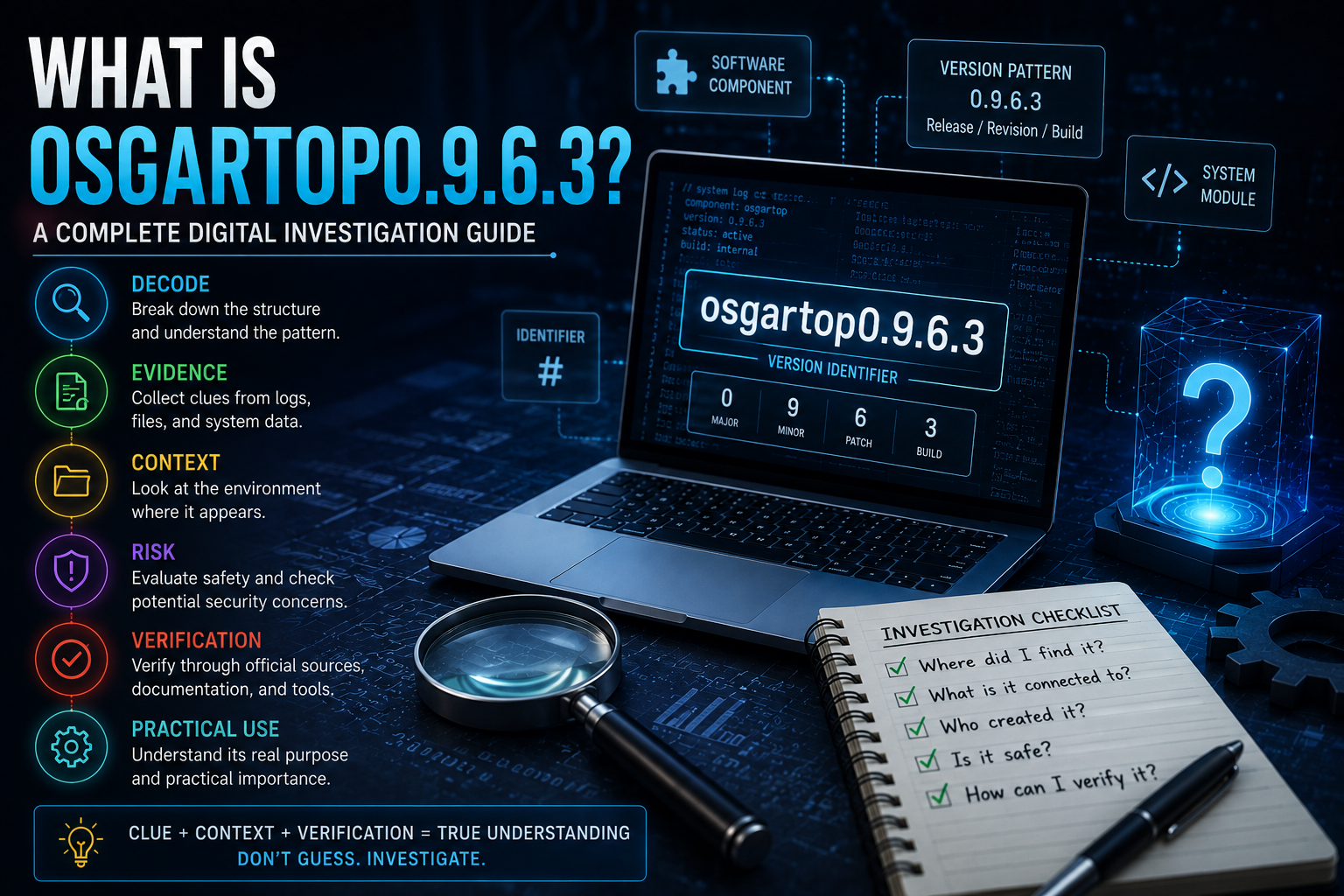
Introduction: When a Digital Name Raises Questions
The internet is filled with technical names that can look confusing at first. Software packages, system components, development builds, configuration references, and version identifiers often use combinations of letters and numbers that are difficult to understand without context. One such term is what is osgartop0.9.6.3.
Unlike an ordinary product name, this identifier has a technical appearance. The word-like section “osgartop” is followed by “0.9.6.3,” creating the impression that the term could be connected with software, a release, a development component, or an internal technical system.
But should the identifier be taken at face value? Not necessarily. A strange technical name can have several possible explanations, and the best way to investigate it is to examine the evidence surrounding it.
This guide takes a different approach. Instead of simply assigning a definition to what is osgartop0.9.6.3, we will investigate its structure, possible origins, digital context, version pattern, verification methods, and practical importance.
Phase One: Decode the Pattern
1. Start With the Visible Structure
The first clue in what is osgartop0.9.6.3 is its unusual construction.
The identifier appears to contain two major elements:
osgartop + 0.9.6.3
The first portion looks like a project or component name. The second portion resembles a multi-level version or revision number.
This type of naming structure is common in technical environments. Developers often combine a project name with numbers so that different releases can be distinguished.
However, the structure does not provide enough information to determine the exact identity of the software or system involved.
2. Why the Letters Matter
The “osgartop” portion of what is osgartop0.9.6.3 is particularly interesting because it does not immediately resemble a widely recognized consumer technology brand.
Technical projects can have unusual names for many reasons. A developer may select an internal project name, an abbreviated term, a codename, or a name generated for a specific system.
The important point is that an unfamiliar name should not automatically be considered suspicious.
Thousands of legitimate software libraries and internal components have names that ordinary users have never heard before.
3. Why the Numbers Matter
The second clue in what is osgartop0.9.6.3 is the four-part numerical sequence.
Software versioning frequently uses numbers separated by periods. A project might use different sections for major versions, minor releases, patches, builds, or revisions.
For example, a developer could use a structure such as:
Major.Minor.Patch.Build
But this is only a general example. The actual creator of a project decides how its numbering system works.
Therefore, the sequence “0.9.6.3” should be treated as a version-style clue rather than a guaranteed interpretation.
Phase Two: Look Beyond the Name
4. A Name Alone Is Not Enough
When someone searches what is osgartop0.9.6.3, it can be tempting to believe that the first explanation appearing online is automatically correct.
That is not a reliable research method.
Search results may contain outdated information, copied descriptions, assumptions, or articles written without access to original documentation.
A much stronger approach is to ask:
- Where did the identifier appear?
- What software was nearby?
- Who published it?
- Was it inside a file?
- Was it part of a website?
- Was it mentioned in a technical document?
- Was a version number displayed alongside it?
These details can completely change the interpretation.
5. The Source Can Reveal the Purpose
The context surrounding what is osgartop0.9.6.3 may provide more information than the identifier itself.
Suppose it appears inside a software installation directory. In that case, it could be associated with an application component or dependency.
If it appears in a developer log, it may represent a build or release reference.
If it appears in a package name, it may identify a particular version of an installable component.
If it appears in a configuration file, it could represent a dependency or system module.
The location therefore becomes a critical part of the investigation.
Read more: 30.6df496–j261x5 Explained: 7 Powerful Clues to Understand This Digital Reference
Phase Three: Consider the Most Likely Categories
6. Could It Be a Software Version?
One reasonable possibility for what is osgartop0.9.6.3 is that it represents a software project combined with a specific version.
Version numbers help developers distinguish different states of a project. A single software application may have dozens, hundreds, or even thousands of releases during its lifetime.
The exact version can matter when troubleshooting compatibility issues or comparing features.
However, without original documentation, it would be inappropriate to claim that every part of the number has a specific official meaning.
7. Could It Be a Component or Dependency?
Another possibility is that what is osgartop0.9.6.3 refers to a smaller software component rather than a complete application.
Modern applications rarely operate as one giant piece of software. They often depend on libraries, packages, frameworks, modules, services, and other components.
A user may therefore encounter a technical identifier without ever intentionally installing that particular component.
This is normal in many software environments.
8. Could It Be an Internal Build?
The identifier might also be associated with an internal build or testing environment.
Developers frequently create multiple versions while working on a project. A build number allows teams to identify exactly which version was tested or deployed.
In this context, what is osgartop0.9.6.3 could function as a reference for a particular software state rather than a public-facing product name.
Phase Four: Understand the Versioning Clue
9. What Could “0.9” Suggest?
The “0.9” portion of what is osgartop0.9.6.3 may look like an early software version.
In some development environments, version numbers beginning with zero are used for projects that have not yet reached a conventional 1.0 release.
This can indicate experimental, pre-release, beta, or development software.
However, this is not a universal rule.
Some developers use version numbers differently, and an opening zero alone cannot prove that a project was experimental.
10. What Could “6.3” Represent?
The final portion of what is osgartop0.9.6.3 could represent a patch, revision, build, or another internal sequence.
For example, a development team might use the final number to distinguish small changes between builds.
But again, the exact meaning depends on the creator’s versioning convention.
This is why technical research should avoid turning assumptions into facts.
Phase Five: Investigate the Digital Environment
11. Check the Operating Environment
When researching what is osgartop0.9.6.3, identify the environment where you discovered it.
Was it on:
- Windows?
- Linux?
- macOS?
- A server?
- A development machine?
- A cloud platform?
- A website?
- A database?
- A package management system?
The environment can narrow down the possible meaning considerably.
12. Examine Nearby Files
If the identifier is connected with a file, examine the surrounding files.
Look for:
- file names;
- extensions;
- folders;
- publishers;
- timestamps;
- configuration files;
- documentation;
- installation records.
This information may help explain the relationship between the identifier and the software environment.
13. Look for Related Names
Another useful technique when investigating what is osgartop0.9.6.3 is to look for related identifiers.
A software package may appear alongside other dependencies. A configuration file may contain a project name. A log may mention both the component and its publisher.
These relationships can provide evidence that is impossible to obtain from the identifier alone.
Phase Six: Separate Evidence From Internet Claims
14. Why Online Information Should Be Compared
The search for what is osgartop0.9.6.3 may produce pages with different explanations.
This is common with obscure technical terms. Once a phrase appears online, other websites may repeat or expand the original claim without independently checking it.
That creates a chain of repetition.
A statement appearing on ten websites does not necessarily become ten pieces of independent evidence.
Instead, look for the earliest and most authoritative source available.
15. Prefer Primary Sources
When investigating what is osgartop0.9.6.3, prioritize:
- official project documentation;
- developer repositories;
- package registries;
- release notes;
- verified technical documentation;
- publisher information;
- established software databases.
These sources can provide stronger evidence than generic articles.
If an official source cannot be found, clearly distinguish between confirmed information and reasonable possibilities.
Read more: Top 10 AI Apps Making Smart Homes Smarter in 2025
Phase Seven: Is It Safe?
16. Do Not Judge Safety From the Name
A major concern behind what is osgartop0.9.6.3 may be whether it is safe.
The identifier itself cannot answer that question.
A strange name does not automatically indicate malware, spyware, or another security problem.
Likewise, a familiar name does not automatically guarantee safety.
Security depends on factors such as the source, publisher, file behavior, digital signature, reputation, and technical analysis.
17. Before Opening an Unknown File
If you found what is osgartop0.9.6.3 connected with an unfamiliar executable or installer, take a cautious approach.
First identify the publisher.
Then determine where the file came from.
Check whether it was installed by software you recognize.
Use reputable security software to scan suspicious files.
Avoid running unknown executables simply because a website claims they are necessary.
This approach reduces unnecessary security risks.
Phase Eight: Why This Identifier Could Be Useful
18. Version Tracking
Understanding what is osgartop0.9.6.3 may be useful because precise version information helps developers track changes.
A developer can identify which release introduced a feature or caused a problem.
19. Troubleshooting
Technical support teams often request version numbers when investigating errors.
Knowing the exact release can help reproduce a problem.
20. Compatibility Management
Different software versions may interact differently with operating systems, databases, libraries, or other dependencies.
An exact identifier can therefore help determine compatibility.
21. Maintenance
Version identifiers also help organizations keep track of installed components and determine which ones may need updating.
This makes technical identifiers useful even when they appear meaningless to ordinary users.
Phase Nine: A Practical Investigation Checklist
If you want to determine what is osgartop0.9.6.3, follow this checklist.
Step 1: Copy It Exactly
Do not change the letters, numbers, periods, or capitalization.
Step 2: Record Where You Found It
The original location is extremely important.
Step 3: Identify the Related Software
Determine whether an application, package, website, or system component is connected to it.
Step 4: Search the Exact Phrase
Exact-match searching can reveal references using the same identifier.
Step 5: Find the Original Source
Look for official documentation, repositories, release notes, or publisher information.
Step 6: Compare the Evidence
Check whether different sources agree.
Step 7: Verify Before Acting
If the identifier is connected with an unknown file, investigate its safety before opening or installing it.
Following these steps makes researching what is osgartop0.9.6.3 much more reliable.
What Makes a Good Identification?
A good answer should not simply say that what is osgartop0.9.6.3 is “software” or “a code.”
A useful identification should explain:
- what created it;
- where it is used;
- what the name represents;
- what the version means;
- what system it belongs to;
- whether it is public or internal;
- and how the information was verified.
Without these details, an identification may remain incomplete.
This is particularly important for unusual technical identifiers because small differences in spelling or context can point to entirely different systems.
Common Mistakes to Avoid
When searching what is osgartop0.9.6.3, users should avoid several common mistakes.
Mistake 1: Trusting the First Search Result
The first result is not necessarily the most authoritative.
Mistake 2: Assuming Every Technical Code Is Dangerous
Unfamiliar does not mean malicious.
Mistake 3: Assuming Every Version Number Uses the Same Rules
Developers can create their own numbering systems.
Mistake 4: Ignoring the Original Context
Where the identifier appeared can be more important than its appearance.
Mistake 5: Installing Software Just to Investigate It
You should not download or execute unknown software merely to discover what a name means.
These mistakes can make what is osgartop0.9.6.3 seem more mysterious than it actually is.
Frequently Asked Questions
Is what is osgartop0.9.6.3 a software product?
It appears to have a software-related naming structure, but the identifier alone does not establish whether it is a complete product, component, package, or internal build.
Is what is osgartop0.9.6.3 a version number?
The “0.9.6.3” portion strongly resembles a multi-part version or revision sequence, but the exact numbering convention should be confirmed through original documentation.
Can what is osgartop0.9.6.3 be an internal identifier?
Yes. Software organizations commonly use internal names and version references for development components, packages, builds, and system modules.
Is what is osgartop0.9.6.3 malware?
There is not enough information in the identifier alone to make that determination. The source and associated file or software must be investigated.
Why does what is osgartop0.9.6.3 look unusual?
Its combination of a word-like project name and a four-part numerical sequence gives it a highly technical appearance.
How can I verify what it is?
Find the original location, identify the associated software or file, search the exact identifier, and compare the results with official documentation and trustworthy technical sources.
Final Analysis: Turning a Strange Code Into Useful Information
At the end of the investigation, what is osgartop0.9.6.3 is best approached as an unusual technical identifier rather than a term that can be decoded with certainty from its characters alone.
Its structure suggests that “osgartop” may function as a project, component, or system name, while “0.9.6.3” resembles a detailed version, revision, or build sequence.
The most important lesson is that technical identifiers require context.
If you find the identifier in a software folder, investigate the application and related files. If it appears in a log, examine the surrounding entries. If it appears in a download package, investigate the publisher and source. If it appears in documentation, follow the references back to the original project.
Ultimately, what is osgartop0.9.6.3 cannot be answered responsibly through guesswork. A reliable explanation should be based on evidence, source verification, technical context, and careful comparison.
For anyone encountering what is osgartop0.9.6.3 for the first time, the best strategy is simple: observe first, investigate second, verify third, and act last.
That approach not only helps explain this particular identifier but also provides a practical method for understanding countless other unfamiliar digital codes found across modern software systems.
