
Introduction
Digital platforms are no longer judged only by how well they perform basic functions. Users also expect clear navigation, meaningful interaction, visible progress, and experiences that encourage them to return. This is why gamification has become an interesting concept for websites, applications, learning platforms, communities, and businesses.
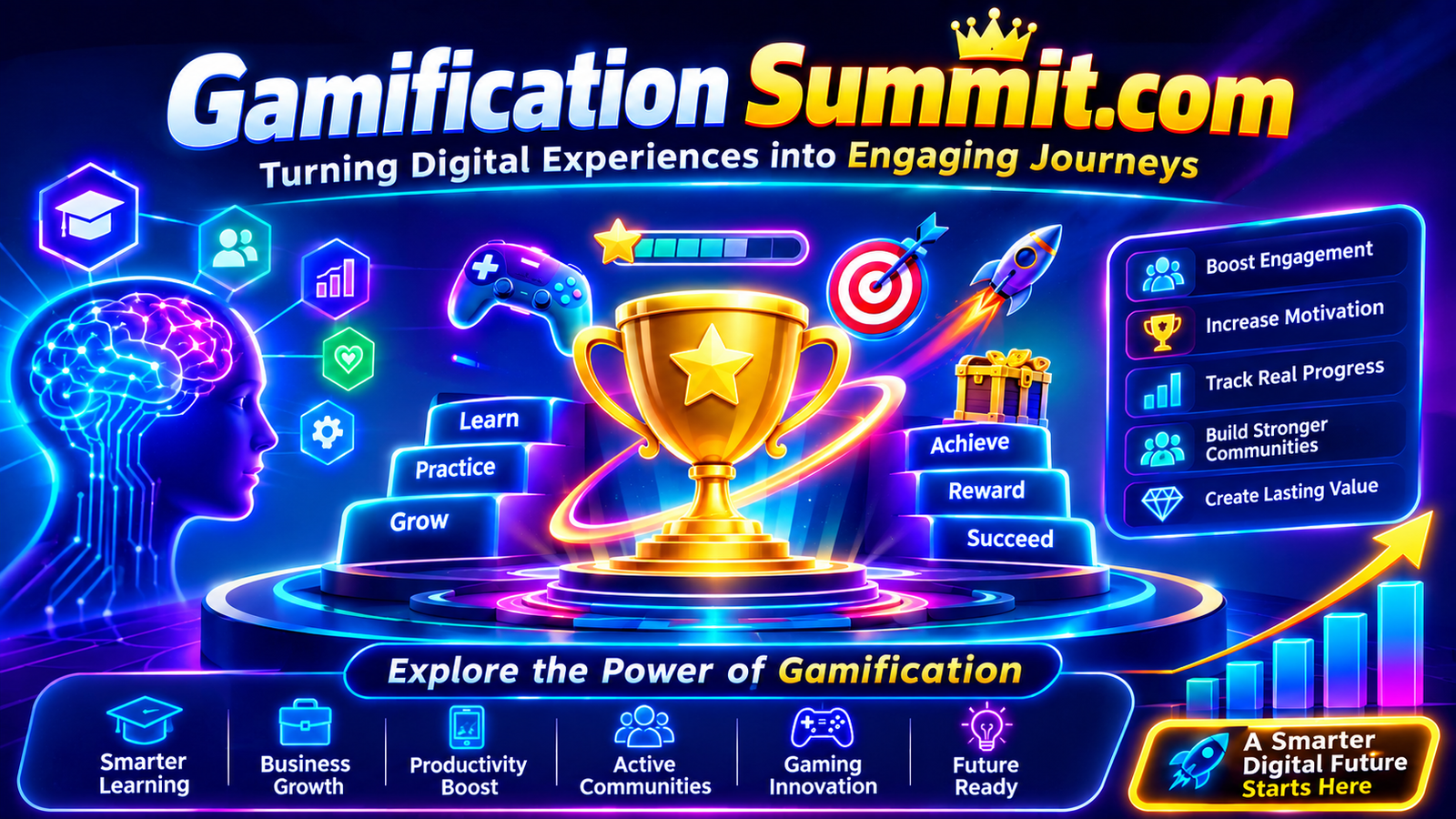
Gamification Summit.com is a useful search topic for understanding how game-inspired principles can be adapted to modern digital experiences. Gamification does not mean turning every website into a video game. Instead, it involves selecting useful elements such as goals, challenges, achievements, progress indicators, rewards, and feedback.
These elements can help users understand what they should do next and how their actions contribute toward a larger objective.
For example, an educational website can divide a course into milestones. A software platform can guide new customers through an onboarding journey. A productivity application can use personal targets to make progress easier to visualize.
The most important principle is simple: gamification should solve a real problem. Adding points or badges without a clear purpose does not automatically create a better user experience.
Understanding the Core Idea
At its foundation, Gamification Summit.com can be explored through one simple question: how can digital products make useful activities easier and more motivating?
A game-inspired system usually begins with an objective. Users need to know what they are trying to accomplish.
The next step is action. There should be a clear activity that moves users toward the objective.
After that comes feedback. Users should understand whether their action was successful.
Finally, progress gives users a sense of movement.
The Four Basic Elements
A simple framework includes:
- Goal
- Action
- Feedback
- Progress
These elements can work independently, but they become more powerful when connected.
1. Start With a Meaningful Goal
The first step in a successful gamification strategy is identifying the desired outcome.
A business may want customers to complete onboarding. An educator may want students to finish a course. A community manager may want members to contribute useful information.
Without a clear objective, game-inspired features can become unnecessary decoration.
Gamification Summit.com becomes more useful when it is considered as a strategy for connecting user behavior with meaningful outcomes.
Examples of Digital Goals
A platform may want to:
- Increase course completion
- Improve customer onboarding
- Encourage useful participation
- Support employee training
- Improve customer loyalty
- Help users complete personal tasks
Once the goal is defined, the team can decide which mechanics are appropriate.
Read more: Getwhocares.com for Gamers
2. Make Progress Easy to See
Large projects can sometimes feel difficult because users cannot see how much they have completed.
Breaking a journey into smaller stages can make the experience easier to understand.
For example:
Start → Learn → Practice → Complete → Advance
Each stage gives users a clear milestone.
This is an important concept associated with Gamification Summit.com because visible progress can provide direction without requiring complicated game mechanics.
Progress Should Represent Real Achievement
A progress bar should ideally represent something meaningful.
If users receive progress simply for clicking through pages, the measurement may not reflect genuine achievement.
Better systems connect progress with useful actions.
3. Use Challenges Carefully
Challenges give users a specific target.
They do not always need to involve competition. A challenge can simply encourage someone to complete a useful task.
An online course might ask students to complete three exercises. A productivity platform might create a weekly target. A community might introduce a shared activity.
In the context of Gamification Summit.com, challenges work best when they support a clear objective.
Keep Challenges Realistic
A challenge should provide direction without becoming unnecessarily difficult.
Short, achievable goals can help users experience progress more frequently.
The difficulty can also change depending on user experience.
4. Create Rewards With Real Value
Rewards are commonly associated with gamification, but their usefulness depends on context.
Possible rewards include:
- Recognition
- Badges
- Certificates
- Discounts
- New content
- Access to features
- Membership levels
- Personal milestones
The best reward depends on the audience.
A student might value a certificate, while a customer might appreciate a discount.
Gamification Summit.com can therefore be viewed as part of a larger conversation about connecting rewards with meaningful user actions.
Read more: Philosophical Truth vs. Social Truth
Avoid Too Many Rewards
If every small action produces a badge, badges can quickly lose their significance.
Recognition should be connected with genuine milestones.
5. Improve Digital Learning
Education is one of the strongest examples of practical gamification.
Online courses can contain many lessons, exercises, assignments, and assessments. A long learning journey may become easier to follow when it is divided into smaller stages.
A simple structure could be:
Explore → Practice → Test → Review → Advance
Each stage provides a clear purpose.
This approach related to Gamification Summit.com does not require a complete gaming system. Simple progress indicators and meaningful milestones may be enough.
Learning Must Remain the Priority
Students should not focus so heavily on points that they forget the actual subject.
Gamification should support learning, not replace it.
6. Simplify Software Onboarding
Software applications can contain many features, which can make the first experience confusing.
A structured onboarding process can introduce important tools gradually.
For example:
Create Account → Complete Profile → Create Project → Explore Features → Finish Setup
A progress indicator can show how much of the setup has been completed.
This is another practical area where Gamification Summit.com concepts can be applied.
Give Experienced Users More Freedom
New users may appreciate guidance, but experienced users may prefer to move quickly.
Good onboarding systems provide assistance without unnecessarily restricting users.
7. Strengthen Gaming Communities
Gaming communities naturally involve interaction, participation, collaboration, and competition.
Players may share strategies, discuss games, organize events, help beginners, and create community content.
Recognition systems can encourage positive participation.
This makes Gamification Summit.com relevant to gaming communities as well as educational and business platforms.
Recognition Does Not Always Need Money
A community can recognize useful contributions through:
- Contributor badges
- Helpful-member labels
- Community milestones
- Featured contributions
- Participation achievements
The goal should be encouraging constructive behavior.
Competition Should Be Optional Where Possible
Some people enjoy leaderboards, while others prefer personal progress.
Offering different participation styles can create a more inclusive environment.
8. Use Feedback at the Right Time
Feedback tells users what happened after an action.
A completed lesson might show a confirmation. A finished task could update progress. A successful milestone might unlock recognition.
These interactions make the system easier to understand.
Gamification Summit.com can also be examined through the role of immediate and meaningful feedback.
Avoid Notification Overload
Too many pop-ups can become distracting.
Important milestones should receive stronger feedback than routine actions.
The goal is useful communication, not constant interruption.
9. Personalize the Experience
Different users have different needs.
A beginner may require simple instructions, while an experienced user may prefer advanced challenges.
Personalization can help platforms adapt the experience.
For example, a learning platform could recommend introductory material to a new student and advanced activities to someone with more experience.
This creates another important connection with Gamification Summit.com.
Personalization Requires Responsibility
If a platform uses behavioral information, users should understand how their information is being used.
Personalization should provide genuine value without unnecessary data collection.
10. Measure What Actually Matters
A gamification project should be evaluated according to its original goal.
If the objective is course completion, measure course completion.
If the objective is onboarding, measure successful onboarding.
If the objective is community participation, focus on useful participation rather than simply counting clicks.
This measurement approach is central to Gamification Summit.com as a practical digital strategy.
Useful Metrics
Depending on the platform, teams may monitor:
- Completion rate
- Retention
- Participation
- Feature adoption
- Learning progress
- Customer satisfaction
- Task success
- User feedback
Metrics should be selected before launch whenever possible.
Gamification for Customer Loyalty
Customer loyalty programs have existed for many years, but digital platforms can make them more interactive.
A customer may earn points, reach membership levels, unlock benefits, or complete special activities.
The important thing is that the reward structure should be easy to understand.
Gamification Summit.com can be considered in this context as part of a broader approach to customer engagement.
Keep the Value Exchange Clear
Customers should understand:
- How rewards are earned
- What benefits are available
- When rewards become available
- Whether rewards expire
- What each membership level provides
Complicated rules can reduce trust.
Gamification in the Workplace
Businesses can also use game-inspired principles for employee development.
Training programs can be divided into modules and milestones.
An employee might progress through:
Learn → Practice → Demonstrate → Complete
Each stage gives the employee a clear understanding of progress.
This workplace application adds another dimension to Gamification Summit.com.
Team-Based Learning
Some organizations may prefer collaborative challenges instead of individual rankings.
Employees can work together toward shared learning objectives.
This approach can encourage cooperation while maintaining measurable goals.
Gamification and Productivity
Productivity applications can use simple progress systems to make tasks easier to visualize.
A user might track:
- Daily tasks
- Weekly goals
- Project milestones
- Study sessions
- Personal objectives
The system does not need to become competitive.
Personal progress can be enough.
Gamification Summit.com is relevant here because productivity is another example of a non-game environment where selected game-inspired mechanics may support user motivation.
Avoid Turning Productivity Into Pressure
Too many notifications or aggressive streak systems can make productivity tools frustrating.
A better approach is to make interactive features optional and supportive.
Technology and the Future of Gamification
Technology is creating new opportunities for interactive experiences.
Artificial intelligence can help personalize recommendations. Analytics can reveal where users struggle. Mobile technology can deliver interactive experiences across different environments.
These developments make Gamification Summit.com relevant to discussions about the future of digital engagement.
Personalized Challenges
Future platforms may create challenges according to individual progress.
A beginner could receive simple objectives.
An experienced user could receive more advanced tasks.
This approach may make digital experiences feel more relevant.
Smarter Feedback
Feedback may also become increasingly contextual.
Instead of showing identical messages to every user, systems can adapt feedback according to activity and progress.
The objective should still be simplicity.
Technology should improve the experience rather than make it more complicated.
Responsible Gamification
Engagement should not be the only objective.
A system that encourages users to click constantly without providing meaningful value should not automatically be considered successful.
Responsible design should consider:
- Transparency
- Accessibility
- Privacy
- User control
- Meaningful rewards
- Appropriate competition
- Clear rules
A responsible approach strengthens the long-term value of Gamification Summit.com strategies.
Respect User Choice
Users should have reasonable control over notifications and participation.
A platform should avoid confusing mechanics designed to pressure people into unwanted actions.
Consider Accessibility
Interactive systems should be designed for people with different needs.
Important information should not depend only on color, movement, or complex interactions.
Common Mistakes to Avoid
Gamification can fail when features are added without understanding the actual problem.
Mistake 1: No Clear Objective
Badges and points cannot fix an undefined goal.
Mistake 2: Too Much Competition
Competition may not suit every user.
Mistake 3: Meaningless Rewards
Rewards lose value when they are given too frequently.
Mistake 4: Complicated Rules
Users should quickly understand how the system works.
Mistake 5: Vanity Metrics
More clicks do not necessarily mean better engagement.
Mistake 6: Ignoring Feedback
User feedback should influence future improvements.
These mistakes demonstrate why Gamification Summit.com should be treated as a thoughtful strategy instead of a quick engagement trick.
A Simple Implementation Roadmap
Organizations can follow a straightforward process.
Step 1: Identify the Problem
Find the specific area where users need support.
Step 2: Define the Goal
Choose one measurable outcome.
Step 3: Understand the Audience
Learn what motivates the target users.
Step 4: Choose One Mechanic
Start with the simplest useful option.
Step 5: Build a Prototype
Test the basic idea before making a large investment.
Step 6: Test With Users
Observe how real people interact with it.
Step 7: Measure Results
Compare the results with the original objective.
Step 8: Improve
Keep useful features and remove unnecessary ones.
This process can make a Gamification Summit.com strategy easier to evaluate.
Secondary Keyword Opportunities
The supplied secondary keyword group includes several getwhocares phrases.
These should be treated as separate search variations rather than automatically presented as official products, features, or partnerships.
Important variations include getwhocares.com for gamers, getwhocares.com entertainment, getwhocares.com tech, getwhocares.com around, getwhocares.com games, getwhocares.com home, getwhocares.com, and getwhocares.com gaming.
Gaming Search Intent
The phrase getwhocares.com for gamers has gaming-related search intent.
Likewise, getwhocares.com games and getwhocares.com gaming are related to gaming searches.
These phrases should not automatically be described as features of a gamification platform without supporting information.
Technology and Entertainment
getwhocares.com entertainment represents entertainment-related search intent, while getwhocares.com tech represents technology-related intent.
These can be kept as separate secondary keyword variations.
Additional Search Phrases
Other supplied phrases include:
- getwhocares.com around
- getwhocares.com home
- getwhocares.com
- www getwhocares.com
These phrases can be used carefully where they fit naturally.
Author-Related Search Variations
The keyword group also contains:
- tracy jimenez tech articles getwhocares
- getwhocares jimenez tech articles
- tracy jimenez games articles getwhocares
- jimenez tech articles getwhocares
These should be treated as search queries rather than verified statements about authorship.
A person’s name inside a keyword does not automatically establish that the person wrote a particular article.
This distinction is important for responsible SEO content.
How to Decide if Gamification Is Right
Before adding gamification to a product, teams should ask several questions.
Is There a Real Problem?
If there is no engagement or usability problem, adding game mechanics may not be necessary.
Is the Goal Clear?
The team should know exactly what it wants users to achieve.
Can Progress Be Measured?
The result should be measurable through meaningful metrics.
Is Competition Appropriate?
If competition is unsuitable, personal progress or collaboration may work better.
Does the Feature Add Value?
Every mechanic should have a reason for existing.
These questions help organizations decide whether the ideas discussed through Gamification Summit.com are appropriate for their project.
Frequently Asked Questions
What is Gamification Summit.com?
Gamification Summit.com is the primary focus keyword of this article and is used to discuss gamification, digital engagement, interactive design, motivation, progress systems, and related technology concepts.
What does gamification mean?
Gamification means using selected game-inspired elements in non-game environments.
Is gamification only for gaming websites?
No. It can be used in education, software, business, training, productivity, marketing, and online communities.
Are points required?
No. Points are only one option. Progress indicators, milestones, challenges, feedback, and recognition can also work.
Can gamification support education?
Yes. It can make progress easier to understand and divide large learning objectives into smaller stages.
Are leaderboards necessary?
No. Leaderboards are optional and should depend on the audience and objective.
Can small businesses use gamification?
Yes. Small businesses can start with simple loyalty milestones, customer challenges, referral objectives, or progress systems.
What makes a reward useful?
A useful reward provides meaningful value or recognition and is connected to a worthwhile action.
Can gamification become distracting?
Yes. Excessive notifications, confusing mechanics, and meaningless rewards can hurt usability.
How should success be measured?
Success should be measured against the original objective, such as completion, onboarding, participation, or task success.
Final Thoughts
The central lesson of Gamification Summit.com is that successful gamification starts with purpose.
Points, badges, challenges, levels, rewards, and leaderboards are only tools. Their value depends on how well they support the user’s journey.
An educational platform can use milestones to make a long course easier to navigate. A software company can use onboarding progress to introduce important features. A business can use loyalty levels to communicate benefits. A community can use recognition to encourage constructive participation.
Poor implementation, however, can create unnecessary competition, confusing rules, excessive notifications, or meaningless activity.
The better approach is straightforward: identify a genuine problem, define the desired outcome, understand the audience, select an appropriate mechanic, test it, measure results, and improve the experience.
Future digital products may become more personalized through artificial intelligence, analytics, mobile technology, and adaptive systems.
However, technology alone will not guarantee success.
Good gamification should remain understandable, useful, accessible, transparent, and respectful.
For businesses, educators, developers, marketers, and community managers, Gamification Summit.com offers a useful framework for exploring how game-inspired ideas can improve real-world digital experiences.
The goal is not to make every website feel like a game.
The goal is to make important digital journeys clearer, more motivating, and more rewarding while keeping the original purpose at the center.
