
Introduction
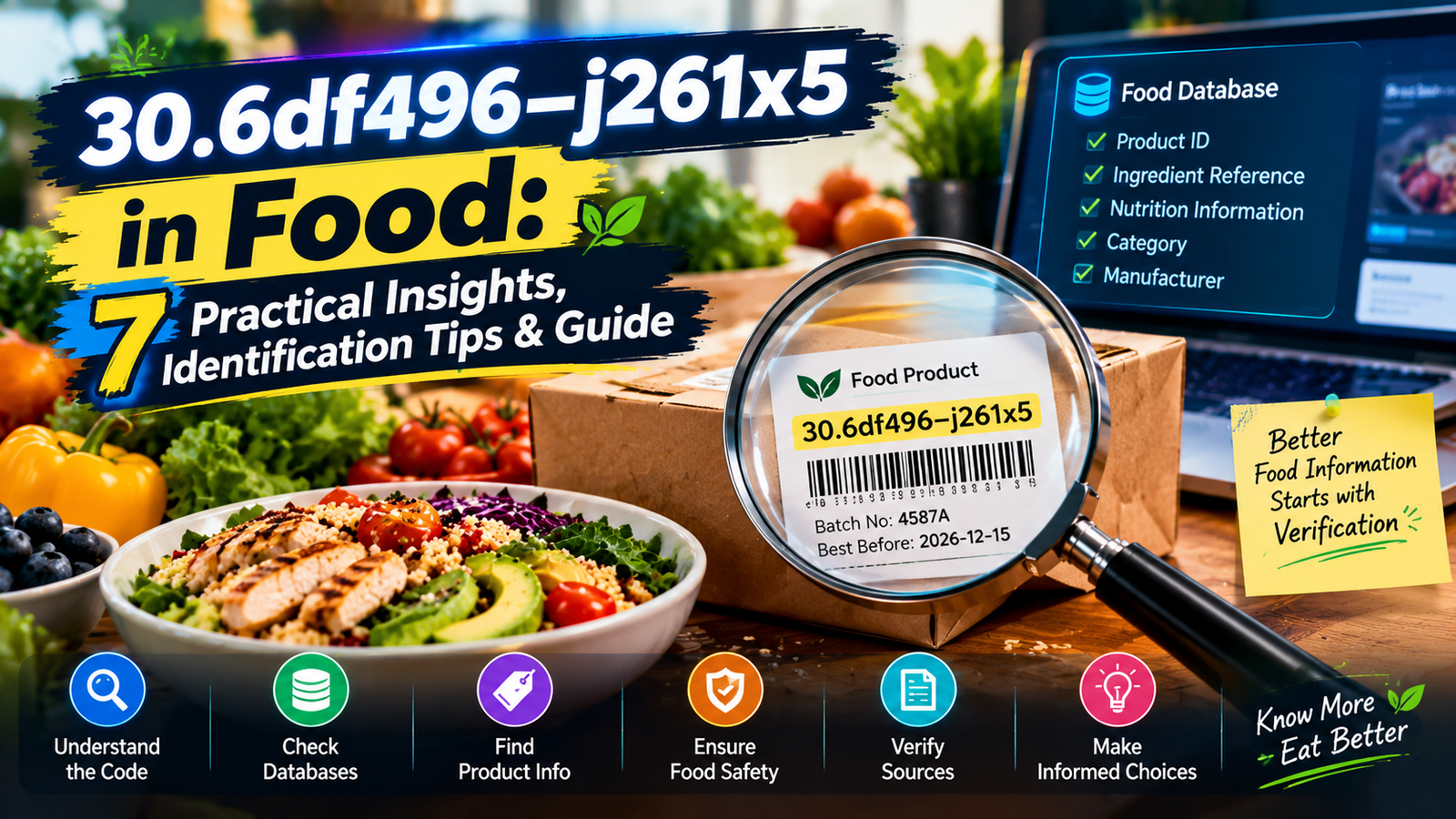
The phrase 30.6df496–j261x5 in food looks more like a technical identifier than the ordinary name of a food, ingredient, recipe, or nutrition term. When an unfamiliar code appears on a food-related website, database, label, image, spreadsheet, or digital document, understanding what it means can be difficult.
Rather than guessing, 30.6df496–j261x5 in food should be approached as an identifier that requires context. A combination of numbers, letters, punctuation, and symbols can have different meanings depending on the system that created it.
This guide explains how to investigate 30.6df496–j261x5 in food, what information can help identify an unfamiliar food code, how digital food records commonly work, and which mistakes should be avoided when interpreting an unknown identifier.
What Could the Identifier Represent?
The exact meaning of 30.6df496–j261x5 in food cannot be established simply by looking at the characters.
A technical string might represent a database record, internal reference, product number, inventory entry, research identifier, or another machine-readable value. The same style of identifier can also be generated automatically by software.
For 30.6df496–j261x5 in food, context is therefore more important than appearance. If the code appears beside a product name, ingredient, nutrition table, or category, those surrounding details may provide clues about its purpose.
The original source should always be identified before making a definite interpretation.
7 Practical Ways to Investigate an Unfamiliar Food Identifier
1. Find the Original Context
The first step when researching 30.6df496–j261x5 in food is to locate exactly where the identifier appeared.
It could come from a website, food database, product label, spreadsheet, research document, inventory system, recipe platform, or software application.
Write down the complete context instead of copying only the identifier. A heading, product name, category, or nearby description may explain its purpose.
2. Read the Surrounding Information
When 30.6df496–j261x5 in food appears on a page, examine the text immediately around it.
Look for labels such as:
- Product ID
- Ingredient ID
- Item number
- Database reference
- Food code
- Record number
- Catalog ID
- Internal reference
These labels can help distinguish a technical identifier from the actual name of a food.
3. Look for a Human-Readable Name
A database may contain both an identifier and a normal food name.
For example, one field might contain a technical reference while another field contains the name of the ingredient, product, or food category.
This is important because 30.6df496–j261x5 in food should not automatically be treated as the name of a food simply because it appears in a food-related record.
The identifier may only exist to help software locate the correct entry.
4. Identify the Database or Website
Another important clue for 30.6df496–j261x5 in food is the platform that generated it.
Different organizations can use completely different coding systems. A product identifier used by a retailer may have no relationship to an identifier used by a nutrition database or research project.
Once the source is known, look for documentation, help pages, data dictionaries, or explanations of the fields used by that system.
5. Examine the Formatting
The unusual structure of 30.6df496–j261x5 in food may indicate that it was generated automatically.
It contains numbers, letters, a decimal point, and an en dash. However, formatting alone cannot establish what each component means.
Readers should treat the structure as a clue rather than proof.
For example, assuming that “30.6” represents calories or that another portion represents an ingredient code would be speculation unless the original system confirms it.
Read more: CryptoProNetwork com adrian: 8 Powerful Research Paths for Smarter Crypto Readers
6. Search the Complete Identifier
If you are trying to understand 30.6df496–j261x5 in food, an exact-string search can sometimes locate the original source.
Keep the characters, punctuation, and spacing as close to the original as possible.
Changing the en dash, removing punctuation, or rearranging characters can produce completely different search results.
If no reliable result appears, that does not necessarily mean the identifier has no purpose. It could belong to a private database, an unpublished system, a newly created record, or a poorly indexed page.
7. Verify Before Making a Claim
The final step for 30.6df496–j261x5 in food is verification.
A trustworthy explanation should come from documentation, the original database, an authoritative product record, or clear information surrounding the identifier.
If its meaning cannot be confirmed, it is better to describe the identifier as unidentified than to invent an explanation.
Why Context Matters in Food Data
Food information is often stored in structured digital systems. A single record can contain a common food name, ingredient list, manufacturer, serving size, nutritional values, product number, category, and internal identifier.
In such systems, 30.6df496–j261x5 in food could be only one field among many.
This means that the code itself may provide very little information about the actual food.
A technical identifier does not automatically tell you whether a product is nutritious, safe, organic, allergen-free, processed, fresh, or suitable for a particular diet.
Those conclusions require separate evidence.
How Food Databases Use Identifiers
Many digital food databases need unique identifiers because food names can overlap.
Two products can have similar names but different ingredients, manufacturers, serving sizes, packaging, or nutritional profiles.
A unique record number allows software to distinguish between them.
If 30.6df496–j261x5 in food belongs to such a system, its main purpose may be organization rather than nutrition.
For example, an identifier could connect a food record with separate fields containing ingredients, calories, serving information, or product details.
What the Identifier Does Not Automatically Tell You
One common mistake when researching 30.6df496–j261x5 in food is assuming that the code itself contains all the information about a product.
The identifier alone does not establish:
- The ingredient list
- Calories
- Protein or carbohydrate content
- Allergen status
- Country of origin
- Manufacturer
- Expiration date
- Quality
- Food safety
- Health benefits
- Health risks
These details require information from an appropriate source.
Food Safety Comes First
If 30.6df496–j261x5 in food appears on or near a physical food product, food safety should take priority over decoding the identifier.
Consumers should examine the complete product label rather than relying on an unfamiliar code.
Important information may include:
- Ingredient list
- Allergen declarations
- Best-before or expiration information
- Storage instructions
- Manufacturer information
- Packaging condition
- Preparation instructions
If a product appears damaged, contaminated, improperly stored, or otherwise suspicious, an unfamiliar identifier should not be used as evidence that the product is safe.
Understanding Ingredients Separately
If 30.6df496–j261x5 in food is connected with an ingredient record, the ingredient itself should be researched separately.
An identifier can point to a database entry without explaining what the ingredient does.
For allergy-related questions, readers should rely on the actual ingredient declaration and appropriate allergen information rather than attempting to decode a technical reference.
When a serious allergy or dietary restriction is involved, qualified professional guidance can be more appropriate than interpreting an unidentified code.
A Simple Research Workflow
A useful workflow for 30.6df496–j261x5 in food can be divided into six stages.
Stage 1: Save the Original Source
Keep the original webpage, image, label, spreadsheet, or document.
Stage 2: Record Nearby Details
Write down the product name, ingredient, category, manufacturer, date, and other information surrounding the identifier.
Stage 3: Identify the Source
Determine which organization, database, website, or application generated the record.
Stage 4: Find Documentation
Search for official explanations, data dictionaries, technical documentation, or field descriptions.
Stage 5: Cross-Check Important Information
If the information relates to nutrition or safety, compare it with reliable food sources.
Stage 6: Preserve Uncertainty
If the meaning remains unclear, state that it has not been confirmed instead of presenting a guess as fact.
Common Mistakes When Decoding Food Codes
People researching 30.6df496–j261x5 in food can easily make several mistakes.
Mistake 1: Assuming It Is a Universal Standard
Not every code is publicly standardized. Some identifiers are created exclusively for internal systems.
Mistake 2: Changing the Characters
Replacing an en dash with a normal hyphen or changing capitalization can create a different search string.
Mistake 3: Ignoring the Original Website
The same-looking identifier can have different meanings in different systems.
Mistake 4: Trusting a Random Search Result
A webpage containing the same characters does not necessarily explain the identifier correctly.
Mistake 5: Turning a Guess Into a Health Claim
An unknown code should never be treated as proof that a food is healthy, unhealthy, safe, unsafe, organic, allergen-free, or suitable for a particular diet.
Organizing Digital Food Records
If 30.6df496–j261x5 in food comes from a personal spreadsheet, inventory platform, recipe database, or research project, keeping the identifier connected with useful information can make future research much easier.
A well-organized record can include:
- Food or product name
- Brand
- Manufacturer
- Category
- Ingredient information
- Date added
- Source
- Reference URL
- Database version
- Notes
Keeping this information together prevents an identifier from becoming separated from the context that gives it meaning.
Food Data and Digital Accuracy
The appearance of 30.6df496–j261x5 in food also highlights a wider issue with digital food information: data quality matters.
Food databases can contain incomplete records, duplicate entries, outdated information, or inconsistent naming conventions.
Reliable digital food systems benefit from:
- Clear field names
- Consistent identifiers
- Source tracking
- Regular updates
- Version control
- Documentation
- Duplicate checking
These practices are useful for food businesses, researchers, developers, nutrition platforms, and anyone managing structured food information.
When Professional Help Is Better
For basic identification, 30.6df496–j261x5 in food can be investigated through the original source and surrounding documentation.
However, professional guidance is more appropriate when an unfamiliar food code is connected with a serious allergy, medical diet, suspected contamination, or another health concern.
A technical identifier should not replace advice from a qualified professional.
For nutrition questions, a registered dietitian or healthcare professional can assess the actual food and relevant nutritional information.
How to Write Accurate Content About an Unknown Identifier
If you are creating SEO content around 30.6df496–j261x5 in food, accuracy should be more important than making unsupported claims.
A trustworthy article can explain that the term appears to be an unfamiliar technical identifier and then provide practical methods for investigating it.
Avoid inventing:
- Chemical identities
- Nutritional values
- Product manufacturers
- Health benefits
- Medical effects
- Safety certifications
unless those details are supported by reliable documentation.
This approach creates content that is more useful and credible for readers.
SEO Strategy for an Unfamiliar Food Term
A page targeting 30.6df496–j261x5 in food should satisfy the searcher’s likely intent quickly.
The introduction should explain that the phrase appears to be an unfamiliar food-related identifier. The following sections can cover identification, database context, food safety, research methods, and common mistakes.
Useful related terms include food identifier, food database code, product ID, ingredient reference, food data, food labeling, ingredient information, digital food records, and food code identification.
Natural language is preferable to repeating the same phrase in every heading.
Quick Identification Checklist
Before relying on information about 30.6df496–j261x5 in food, check these points:
- Is the identifier copied exactly?
- Is the punctuation correct?
- Where did it come from?
- What text surrounds it?
- Is there a product name?
- Is there an ingredient name?
- Is the source documented?
- Can the interpretation be verified?
- Does the information affect food safety?
- Is uncertainty clearly explained?
If important answers are missing, additional research is needed.
Read more: The Role of AI in Enhancing Cybersecurity: Benefits and Challenges
Frequently Asked Questions
What is 30.6df496–j261x5 in food?
The phrase appears to be a technical or system-specific identifier connected with food-related information. Its exact meaning cannot be established from the character string alone.
Is it a food ingredient?
There is not enough information in the identifier itself to establish that it represents an ingredient.
Can the code reveal nutritional information?
Not automatically. Nutritional information normally comes from a food record, nutrition database, product label, or another documented source.
Could it be a product ID?
It could potentially function as a product or database identifier, but the original system would need to confirm that interpretation.
Is a food associated with the code automatically safe?
No. The identifier itself cannot establish food safety. Consumers should use complete product labeling and appropriate food-safety information.
How should I research an unfamiliar food code?
Start with the original source, preserve the exact characters, examine surrounding information, identify the database or organization, locate documentation, and verify important claims independently.
Final Thoughts
The most important lesson about 30.6df496–j261x5 in food is that an unfamiliar identifier should be investigated through context instead of guesswork.
A technical string may represent a database record, product reference, inventory value, research entry, or another digital object. Without the system that created it, its exact meaning cannot be confirmed.
Anyone researching 30.6df496–j261x5 in food should preserve the exact characters, inspect the surrounding information, identify the source, and look for documentation before drawing conclusions.
The responsible approach to 30.6df496–j261x5 in food is simple: verify first, explain second, and avoid unsupported claims.
For consumers, this is especially important when an unfamiliar code could affect allergy information, dietary decisions, or food safety.
Ultimately, 30.6df496–j261x5 in food should be treated as a research clue rather than a complete explanation. Once its original source and associated data are identified, the identifier may become much easier to understand.
